I build AI agents for businesses. Every day. That's literally what I do. And I can tell you something massive shifted in AI this year that most business owners completely missed.
For two years, AI meant chatbots. You type a question, get an answer. Copy. Paste. Switch tabs. Repeat. You were still the one doing all the work. The AI was just a fancier search engine.
That's over now.
The shift nobody explained properly
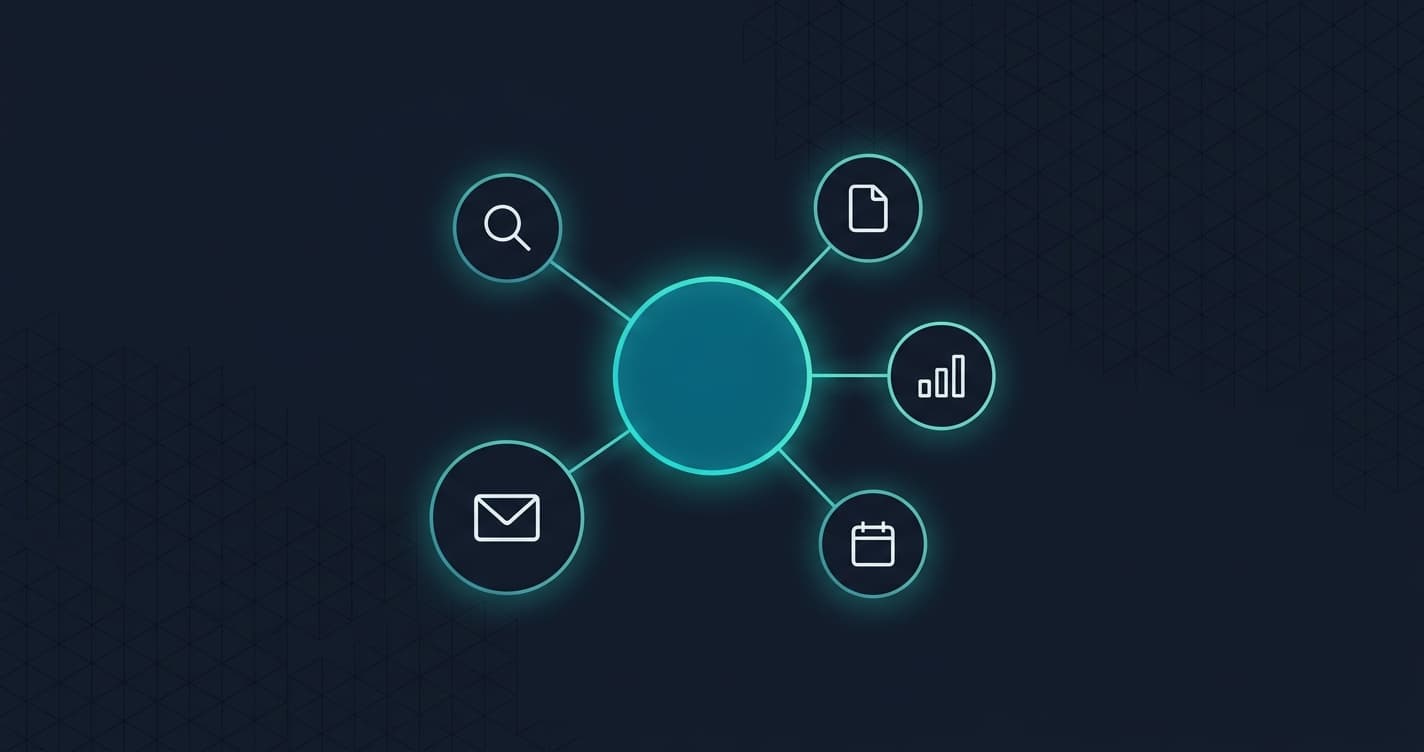
AI agents are not chatbots. A chatbot answers questions. An agent does work. Actual work.
Here's what I mean. With ChatGPT, you ask: "Write me a follow-up email for this client." You get the text. You copy it. You open Gmail. You paste it. You hit send. You did the work. The AI just wrote some words.
With an agent, you say: "Every Tuesday, check my CRM for leads who haven't replied in 7 days. Write them a follow-up based on our last conversation. Put the drafts in my inbox for approval." Then you go do something else. The agent handles the research, the writing, the scheduling.
That's the shift. From asking questions to delegating tasks. From a search engine to an employee.
What an AI agent actually does
I've built agents that do everything from scraping company data to writing personalised cold emails to monitoring pipelines overnight. Three things make them different from every AI tool you've tried:
They take action. Not just generating text. Actually doing things. Browsing websites. Pulling data from your Xero or CRM. Creating documents. Sending messages. Filing things where they belong.
They work autonomously. You give a goal, not step-by-step instructions. The agent figures out the path. If something breaks, it adapts. You don't babysit it through every click.
They learn your business. The more an agent works with your data, your clients, your workflows, the better it gets. Day one is the worst it will ever be. I've seen agents go from clunky to genuinely useful within a week of working alongside a team.
Three things I've actually built for UK service businesses
Forget the Silicon Valley demos. I work with accountancy firms, recruitment agencies, marketing consultancies. 10-50 employees. Here's what AI agents look like in their world.
1. Morning briefs that save 40 minutes a day
I set up an agent that goes out every morning at 6am. It searches industry sources, regulatory updates, competitor news. Filters out the noise. Sends a clean 2-minute summary straight to Telegram before my client even gets to the office.
No subscriptions. No scrolling through newsletters nobody reads. Just the stuff that actually matters for their practice, their clients, their region. One owner told me he used to spend 40 minutes every morning catching up. Now it's done before he opens his laptop.
2. Follow-ups that don't fall through the cracks
A recruitment agency I worked with was processing 118 applications per vacancy. Candidates slipping through. Clients not hearing back fast enough. Scheduling eating everyone's day alive.
I built an agent that monitors their pipeline, flags leads going cold, drafts personalised follow-ups based on previous conversations, and queues them for review. Not generic templates. Actual personalised messages based on context the agent pulled from their CRM.
The numbers: 12-15 hours per week per recruiter freed up from admin. That's not a productivity hack. That's basically hiring an extra team member without the salary.
3. The admin tax nobody talks about
Every service business has it. Invoice chasing. Data entry between systems that should already talk to each other. Weekly reports that take half a day to compile. Client onboarding that's 90% copy-paste.
I connect existing tools (Xero, Bullhorn, HubSpot, email, project management) and build agents that handle the data flow between them. You stop being the human glue between your own software.
Real example: an accountancy practice where the team was spending 120 hours per employee per year on manual data transfer between systems. That's three weeks of billable time per person. Gone. Because their tools weren't connected.
What this actually costs
I'm going to be straight with you because every other article on this topic hides behind "contact us for pricing."
The AI tools themselves are cheap. Model costs dropped over 90% since 2023. Running an agent costs pennies per task. Most of the software is open source.
What costs money is the same thing it's always been: someone who understands your business, maps your workflows, identifies where the biggest time sink is, and builds a working system around it. A generic chatbot is worthless. A system built for your actual processes saves real hours every week.
| Approach | Cost | What you actually get |
|---|---|---|
| DIY with off-the-shelf tools | Free to £50/month | Fine for simple stuff. Falls apart the moment you need anything custom. |
| Pre-built automation setup | £500-£2,000 | Standard workflows only. You're stuck with what templates support. |
| Custom-built system for your business | £1,500-£5,000 | Someone maps your actual processes, finds the highest-impact automation, and builds a working tool in 2 weeks. This is where the ROI lives. |
Quick maths. An agent saving your team 5 hours a week at £25/hour fully loaded = £6,500 per year in recovered capacity. Most builds I do pay for themselves within the first quarter. Some within the first month.
The security question
Everyone asks this. Fair enough.
Here's the honest answer from someone who builds these systems: AI agents do exactly what you tell them to do. They don't randomly access your files or send messages you didn't ask for. The risk isn't the technology. The risk is giving an agent access to things without thinking it through first.
I use enterprise-grade AI (Claude API, Google Vertex AI with UK data residency in London). Your data doesn't train any models. It stays in the UK. I sign a DPA before every engagement. That's just how I operate.
Practical rules I follow with every client:
- Start small. One workflow. One system. Prove it works. Then expand. Don't give an agent the keys to everything on day one.
- Human review on anything client-facing. Every agent I build routes outgoing communications through approval first. Always.
- Business-grade infrastructure only. API access (not consumer chatbots), UK data residency, encryption in transit and at rest. No shortcuts.
- Treat it like a new hire. If you wouldn't let a new employee send client emails unsupervised on their first day, don't let an agent do it either.
Where this is heading
I spend a lot of time thinking about this because it's literally my business. Two things are coming fast:
AI running locally on your own hardware. Instead of sending data to the cloud, you run models on a device in your office. Completely private. Completely free after setup. Open-source models are getting dramatically better every week. I'm already testing this on my own server. It works. Give it 6 months and this will be mainstream.
Agents talking to each other. Right now, most businesses use AI tools in isolation. Soon your accounting agent flags an unusual expense, your compliance agent checks it against HMRC rules, and your comms agent drafts the client query. All without you in the middle. I'm building this kind of agent-to-agent orchestration right now. It's the next big thing in this space.
The businesses that start building AI infrastructure now, even something simple, will be years ahead when these capabilities become the norm. The ones who wait will be playing catch-up.
Bottom line
AI agents are the first AI technology that actually takes work off your plate instead of adding to it. No more copy-pasting between systems. No more being the human glue holding your software together.
I've shipped two apps to the App Store. I build AI systems for UK service businesses every day. And I can tell you: if you're running a business with 10-50 people and your team spends more than 5 hours a week on repetitive admin, there is almost certainly an agent that could handle it.
The technology is ready. The costs are reasonable. The only thing missing is someone to build it for your specific situation.
Find out what an AI agent could handle in your business
Fortnight & Co builds working AI systems for UK service businesses in 14 days. If we can't find a use case that saves your team 5+ hours per week, you don't pay.
Get your free automation auditFree - 20 minutes - No obligation - Custom report